RSS

Blog | Jodi Bernard | PEI Real Estate Guides & Insights

PEI Lands Protection Act Explained

Understanding land ownership rules in Prince Edward Island can be confusing—especially for waterfront properties, acreage limits, and non-resident buyers. This guide breaks down the PEI Lands Protection Act in plain language, including who needs approval, what counts toward acreage limits, and common misconceptions I see in real transactions.

👉 Read the full guide:
https://jodibernard.com/pei-lands-protection-act-explained.html


PEI Closing Cost Explained

Learn what PEI home buyers should expect to pay at closing, including land transfer tax, legal fees, adjustments, inspections, and title insurance.

👉 Read the full guide:
https://jodibernard.com/pei-closing-costs.html


PEI Home Inspection Checklist

Understand the real closing costs for PEI home buyers—land transfer tax, legal fees, inspections, adjustments, and whether title insurance makes sense.

👉 Read the full guide:
https://jodibernard.com/pei-home-inspection-checklist.html


PEI Winter Home Buying

Discover why winter can be one of the smartest times to buy a home on PEI—less competition, motivated sellers, and the chance to see how a home truly performs in harsh weather.

👉 Read the full guide:
https://jodibernard.com/winter-home-buying-pei.html


Moving to PEI From Ontario

Thinking about moving to PEI from Ontario? Learn what really changes—from housing and heating to wells, septic systems, and lifestyle differences you won’t see in online listings.

👉 Read the full guide:
https://jodibernard.com/moving-to-pei-from-ontario.html


PEI Well Water Testing

Private wells are common on PEI. This guide explains how well water testing works, what buyers should test for, and how results affect your purchase.

👉 Read the full guide:
https://jodibernard.com/pei-well-water-testing.html


Selling a Home in PEI? Costs Most Sellers Forget

From legal fees to adjustments and unexpected repairs, here are the expenses most people forget to budget for.

👉 Read the full guide:
https://jodibernard.com/selling-a-home-in-pei-costs-most-sellers-forget.html


Charlottetown PEI

If you’re considering a move to Prince Edward Island, Charlottetown is often the starting point. This guide covers neighbourhoods, lifestyle, and what day-to-day living is really like in the Island’s capital.

👉 Read the full Charlottetown overview:
https://jodibernard.com/charlottetown.html

Summerside PEI

If you’re considering a move to Prince Edward Island, Summerside is one of the most practical places to start. This guide covers neighbourhoods, lifestyle, and what day-to-day living is really like in one of PEI’s most livable communities.

👉 Read the full Summerside overview:
https://jodibernard.com/summerside.html or https://jodibernard.com/Is-Summerside-a-good-place-to-buy-a-home.html

PEI Beaches

Best beaches in Prince Edward Island, from red sand shores to white sand coastlines. Explore top PEI beaches and local favourites.

👉 Read the full
https://jodibernard.com/pei-beaches.html

How to sell your home fast PEI

Learn how to sell your home fast in PEI with pricing, prep, photos, marketing, and negotiation tips from PEI REALTOR® Jodi Bernard.

👉 Read the full

https://jodibernard.com/how-to-sell-your-home-fast-in-pei.html

First-Time Home Buyers Rebate PEI

The first-time home buyers rebate can recover the federal GST on a new PEI home, up to $50,000. What it covers, and what it does not.

👉 Read the full

https://jodibernard.com/first-time-home-buyers-rebate-pei.html


Read

PEI Real Estate Market Update: September 2026 – Sales Rebound While Prices Hold Steady

September brought a welcome pickup in activity across Prince Edward Island. According to the Prince Edward Island Real Estate Association (via CREA), 201 homes sold through the MLS® System—up 6.9% from September 2025 and the strongest September sales total since 2021. Sales also ran 12% above the five-year average for the month.

Year-to-date, 1,484 homes have sold through the first nine months of 2026, still 9.7% below the same period last year. The September rebound is a positive signal heading into fall, even as overall 2026 activity remains more measured than the hotter years of the recent past.

Prices Remain Stable

The MLS® Home Price Index (HPI) composite/single-family benchmark price was $377,900 in September—nearly unchanged, up just 0.5% year over year. The average price of homes that sold during the month was $409,925, a modest 1.4% gain from September 2025. The year-to-date average sits at $410,668, up 3.1% from the first nine months of 2025.

Dollar volume reached $82.4 million in September, an 8.4% increase and a new record for the month. These numbers show a market that has settled into a more sustainable range rather than seeing sharp declines.

Inventory and Choice for Buyers

New listings totaled 341 in September—the highest number ever recorded for the month and up 4.9% year over year. Active residential listings stood at 1,360 at month-end, the highest September inventory level in a decade. Months of inventory were 6.8, down slightly from 7.2 a year earlier but still above the long-run average of about 5.7 months for this time of year.

In practical terms, buyers continue to have more selection and negotiating room than they did in the peak years, while well-priced and well-presented homes are still moving. Conditions vary by community, price point, and property type—entry-level and move-up homes in stronger pockets continue to see solid interest.

What This Means Locally

On the North Shore and across the Summerside–Kensington corridor, the same broader trends apply, with the added advantage of generally more accessible price points compared with Charlottetown and the eastern side of the Island. Coastal and rural properties remain popular for both primary homes and secondary/lifestyle buyers. With inventory elevated province-wide, serious buyers who are pre-approved and ready to move have good options right now. Sellers who price realistically relative to current comparable sales and prepare their homes well are finding buyers.

The Bank of Canada has held rates steady, supporting affordability relative to the higher-rate period earlier in the cycle. Looking ahead, TD Economics has projected modest price growth for PEI existing homes through the rest of 2026, consistent with the stable-to-slightly-positive trend we’re seeing in the benchmark data.

Bottom line: September showed healthier sales activity, stable prices, and continued choice for buyers. It’s a balanced, price-sensitive market—neither overheated nor in freefall. If you’re thinking of buying or selling on the North Shore, in Summerside, Kensington, or elsewhere on PEI, local conditions and recent comparable sales matter more than the provincial averages.

I’m happy to walk through current listings, recent sales in your target area, or a clear pricing strategy for your home. Reach out anytime.

Jodi Bernard
Century 21 Northumberland

Read

5 Things to Look For When Buying a Waterfront Property in PEI

Prince Edward Island’s red cliffs, dune-backed beaches, and sheltered bays are a big part of why people want to live here. Waking up to the Strait, a quiet cove, or a working harbour is a real lifestyle. It is also a different kind of purchase from an inland lot.

Coastal property on PEI moves. Banks recede, dunes shift, and storm surge does not stop at the property line. The right waterfront home is still a strong buy. The wrong one can cost more to insure, limit what you can build, or lose usable land faster than the listing photos suggest.

As a local REALTOR® with CENTURY 21 Northumberland Realty, I walk buyers through these properties on the North Shore and across the Island. Here are five things I want every waterfront buyer to check before they waive conditions.

1. Shoreline stability and erosion risk

PEI’s coast is soft. Sandstone cliffs can undercut. Sandy shores and dunes migrate. Sheltered bays usually move more slowly than open coast, but no shoreline is frozen in place.

The province’s Coastal Property Guide groups erosion roughly this way: under 30 cm a year is lower risk, 30 to 90 cm a year is moderate, and more than 90 cm a year is high. On a high-rate bank, a few decades can take a meaningful slice of the lot.

Before you get attached to a view, look at the land itself.

  • Walk the bank. Undercut edges, fresh slumping, exposed roots, and failed armour stone are all signals.

  • Ask how the shore has changed, including after Fiona and later storms.

  • Use the province’s Climate Hazard and Risk Information System (CHRIS), which shows about 50 years of coastal change plus flood mapping.

  • Request a free Coastal Hazard Assessment for the specific property. It is one of the most useful documents you can have in hand before you firm up an offer.

A geotechnical opinion is worth it on high banks or cliff lots if you plan to build, add on, or rely on the setback for decades.

2. Water access and what you actually own

“Waterfront” on a listing can mean a sandy beach, a low bank, a steep cliff, or a view across someone else’s land. Those are not the same property.

On tidal water, the ownership line is generally the top of the bank or the ordinary high-water mark. The beach and intertidal area below that line are public. You may have a private path to the shore and still not own the beach in front of you. As the bank erodes, land that was once private can become public foreshore.

Confirm three things in writing:

  • Whether the deed includes water frontage, and what the shore type is.

  • Whether access is practical for how you want to use it: swimming, kayaks, a small boat, or simply a walk to the water.

  • Whether stairs, a path, or a launch already exist, and whether they were permitted.

The best coastal properties pair the view with access you can actually use, in a location that still makes sense after a few hard winters.

3. Buffer zones, setbacks, and permits

This is the point most buyers get wrong, because the numbers sound similar and they are not.

Under the Environmental Protection Act, PEI has a 15-metre (about 49-foot) buffer zone around watercourses and wetlands, measured inland from the high-water mark or top of bank. It is a no-development zone. Cutting for a view, building a shed or deck, landscaping, or installing shoreline protection all need a Watercourse, Wetland and Buffer Zone Activity Permit. Work done without one can bring fines and an order to restore the site.

Setbacks for buildings are separate, and often larger:

  • Beach: 75 feet (22.9 m) from the top of the bank, or 60 times the annual erosion rate, whichever is greater.

  • Wetland or watercourse: 75 feet from the inland boundary.

  • Primary or secondary sand dune: 100 feet (30.5 m) from the inland edge of the dune.

Older lots can have different rules, and municipalities can add their own. A cottage that sits legally today may not be a template for an addition, a garage, or a new build. If the plan is to renovate or rebuild, confirm the setback before you price the project.

The province also does not treat armour stone as the default fix. Relocation and a larger setback are preferred. Shoreline work needs a permit, and usually a licensed contractor. The province does not fund private shoreline protection.

4. Flood risk and whether you can insure it

Erosion and flooding are related, but they are not the same problem. A high bank can be eroding and still sit above surge. A low cottage in a bay can be stable and still take water in a storm.

CHRIS maps both coastal flooding and inland flooding, including depth. A Coastal Hazard Assessment adds property-specific context. Ask the seller about past water in the basement or crawl space, sump pumps, moved mechanical equipment, and any insurance claims.

Then call an insurer before you remove conditions. A standard home policy often excludes overland flood and storm surge. Some coastal homes are insurable with a higher premium or an elevation requirement. Some are difficult to place at all, which can also affect financing. Do not assume the current owner’s policy will transfer.

5. Services, access, and how you will actually live there

A waterfront lot can be twenty minutes from Kensington or Summerside and still feel remote in January.

  • Well water near the coast can be vulnerable to salt. Ask for a recent water test, not just a flow test.

  • Septic systems on coastal soils need enough setback and good drainage. Confirm age, location, and whether a future bedroom addition is even possible.

  • Private or seasonal roads change the winter equation. Ask who ploughs, and what happens in a nor’easter.

  • Salt air and wind exposure wear on siding, windows, metal, and decks. Budget for it.

  • Decide whether this is a year-round home or a seasonal place. The same cottage can be a bargain for one use and a problem for the other.

Before you remove conditions

A short list I use with coastal buyers:

  • Coastal Hazard Assessment requested, and CHRIS reviewed.

  • Shore type, frontage, and public-beach boundary confirmed.

  • Buffer zone and building setback checked against any plan to add or rebuild.

  • Insurer consulted on flood and storm-surge coverage.

  • Well, septic, drainage, and winter access inspected, not assumed.

Buying waterfront on PEI is still one of the better reasons to be here. The buyers who do well are the ones who price the shore they are actually getting, not the shore in the photo.

If you want a second set of eyes on a coastal listing, or a search built around how you plan to use the water, I can help.

Jodi Bernard, REALTOR®                                                                                                                                                CENTURY 21 Northumberland Realty                                                                                         

Read

PEI Real Estate Market Update – April 2026

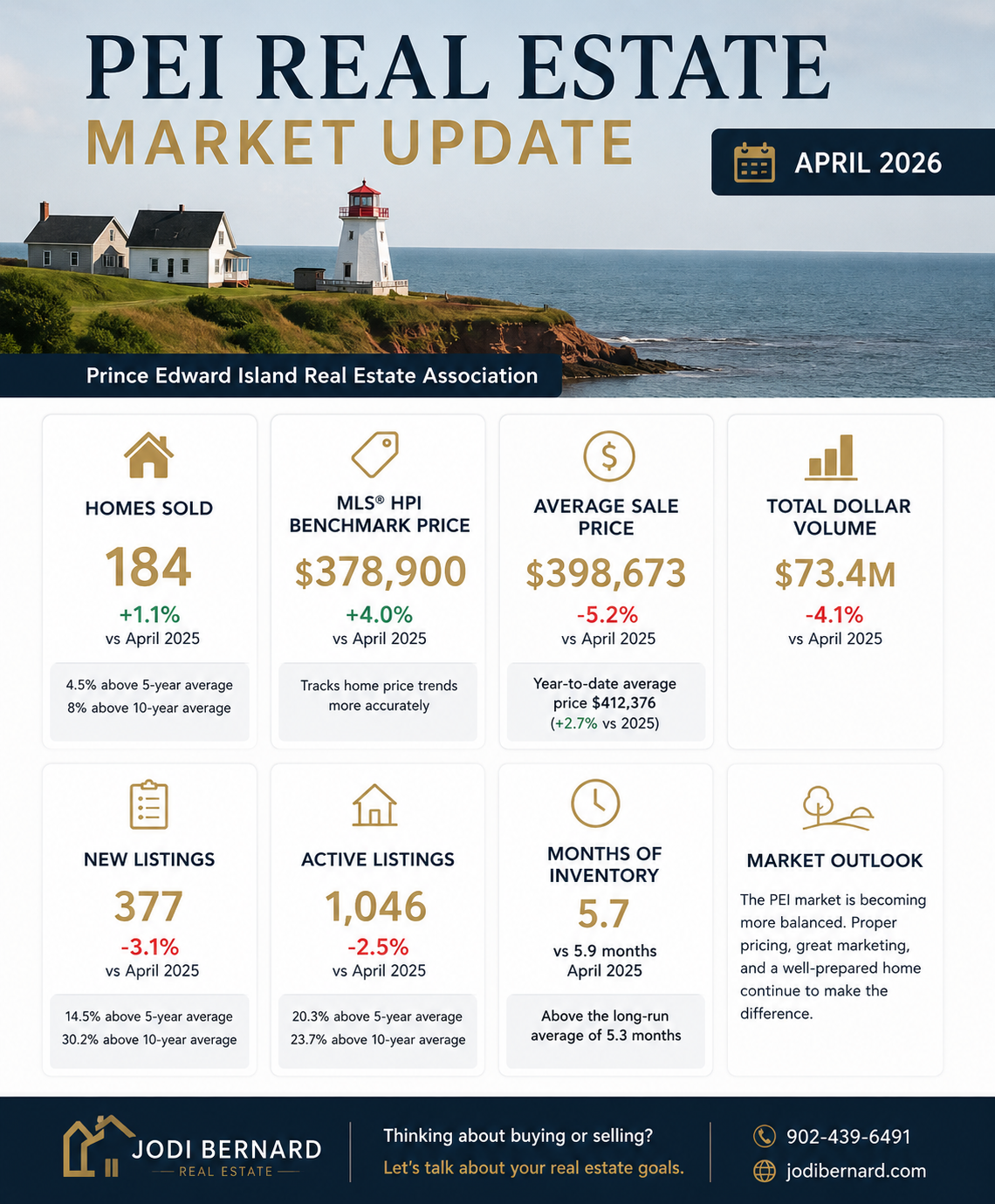
The Prince Edward Island housing market remained active through April 2026, with home sales continuing to outperform long-term averages despite softer year-to-date numbers compared to last year.

According to the Prince Edward Island Real Estate Association (PEIREA), a total of 184 homes were sold through the MLS® System in April 2026. That represents a modest increase of 1.1% compared to April 2025 and sits 4.5% above the five-year average for the month.

Home Prices Continue to Show Stability

The overall MLS® Home Price Index (HPI) benchmark price for single-family homes reached $378,900 in April 2026, increasing 4% year-over-year. The HPI is considered one of the most accurate ways to track home price trends because it measures comparable properties over time rather than relying solely on averages.

The average sale price for homes sold during April was $398,673, down 5.2% from April 2025. However, year-to-date pricing remains positive overall, with the average sale price for the first four months of 2026 sitting at $412,376 — up 2.7% from the same period last year.

Inventory Levels Remain Higher Than Historical Averages

There were 377 new residential listings added to the market in April, a slight decrease of 3.1% compared to last year. Even with that decline, new listings remain well above historical norms:

  • 14.5% above the five-year average

  • 30.2% above the ten-year average

At the end of April, there were 1,046 active residential listings on the market across Prince Edward Island. While this was down slightly from April 2025, inventory levels are still significantly higher than typical seasonal averages.

Months of inventory sat at 5.7 months at the end of April, compared to 5.9 months one year ago. In simple terms, this means it would take approximately 5.7 months to sell all current listings at the current pace of sales if no new homes came to market.

What This Means for Buyers and Sellers

The PEI real estate market is continuing to shift toward a more balanced environment compared to the extremely competitive conditions seen over the past few years.

For sellers:

  • Proper pricing is becoming more important

  • Professional marketing and presentation matter more than ever

  • Well-prepared homes are still attracting strong interest

For buyers:

  • Inventory levels have improved

  • Buyers generally have more choice and negotiating flexibility than during peak market conditions

  • Stable pricing continues to support long-term value

While the pace of the market has moderated compared to previous years, demand across many PEI communities remains healthy, particularly for well-priced homes in desirable locations.

If you’re thinking about buying or selling real estate on Prince Edward Island and would like a local market opinion, feel free to reach out anytime.

Jodi Bernard
PEI REALTOR®
Jodi Bernard Real Estate

Read

Recognized Among Canada’s Top 100 REALTORS®: 2025 Milestones

Consistency matters in real estate. In 2025, I was honoured to be recognized multiple times among Century 21’s Top 100 producers in Canada—reflecting steady results, not just one strong month.

2025 Recognition Highlights

These achievements are based on real production and closed transactions—not projections or marketing metrics.

  • Top 100 Producers by Production (October 2025)
  • Top 100 Producers by Units (October 2025)
  • Outstanding Achievement – Third Quarter 2025
  • Top 100 Producers by Units (July 2025)
  • Pacesetter Platinum – Mid-Year 2025
  • Outstanding Achievement – Second Quarter 2025
  • Outstanding Achievement – First Quarter 2025
  • Top 100 Producers by Units (January 2025)

What These Awards Actually Mean for Clients

Real estate awards only matter if they translate into better outcomes for buyers and sellers. For my clients, these milestones reflect:

  • Consistent performance across different markets and seasons
  • Strong negotiation skills backed by real transaction data
  • Experience with complex deals, rural properties, and conditional purchases
  • Reliable execution—from first showing to closing day

I don’t chase volume for the sake of numbers. Every transaction still gets hands-on attention, honest advice, and a strategy tailored to the property and the client.

Focused on Prince Edward Island Real Estate

My business is built almost entirely on Prince Edward Island real estate—working with local buyers, sellers, and out-of-province clients relocating to PEI.

That means deep familiarity with:

  • PEI neighbourhoods and rural communities
  • Well and septic considerations
  • Waterfront and acreage properties
  • Seasonal and year-round homes
  • PEI-specific buying conditions and timelines

Thank You

These recognitions wouldn’t be possible without the trust of my clients, referrals from past buyers and sellers, and the support of my brokerage at Century 21 Northumberland Realty.

If you’re thinking about buying or selling on PEI in 2025 or beyond, I’m always happy to talk through your plans—even if you’re just gathering information.

— Jodi Bernard, REALTOR®
Century 21 Northumberland Realty

Read

Prince Edward Island Real Estate Market Update – January 2026

20% Dip in PEI Home Sales in January — No Cause for Alarm

Recent data from the Prince Edward Island Real Estate Association (PEIREA) shows that home sales on Prince Edward Island were down more than 20% in January 2026 compared to January 2025. While that headline might sound concerning at first glance, industry experts say it’s largely part of normal seasonal patterns rather than a sign of a declining market.

What the Numbers Show

According to the latest report:

  • 88 homes sold in January 2026
  • 111 homes sold in January 2025
  • New listings dropped 12.5%
  • Benchmark home price reached $371,700, up 1.7% year-over-year

While sales activity slowed, prices remain stable, which suggests the overall market is still balanced.

A Seasonal Market Pattern

Real estate activity on PEI tends to follow a predictable seasonal pattern. Winter months — particularly January — are traditionally slower.

Shorter days, colder temperatures, and snow can make buying or selling more challenging. Many homeowners also prefer to wait until spring when properties tend to show better and buyer activity increases.

Because of this, one slower month does not necessarily indicate a long-term trend.

Buyers Are More Cautious

Economic conditions and higher mortgage costs have made buyers more thoughtful about their decisions.

Compared to pre-pandemic levels, the cost of homeownership has increased significantly due to higher interest rates and larger required down payments. As a result, buyers today are taking more time to review their options, compare properties, and speak with lenders before making an offer.

This doesn’t mean buyers have disappeared — it simply means they are being more deliberate.

A More Balanced Market

Many realtors believe the current market is healthier than the highly competitive conditions seen during the pandemic.

In a balanced market:

  • Buyers have time to conduct inspections and due diligence
  • Sellers still benefit from stable pricing
  • Negotiations become more reasonable for both sides

Buyers are also becoming more informed and research-driven, ensuring they understand the value of a property before committing.

What This Means for Buyers and Sellers

For buyers, the current environment can present opportunities. With less urgency in the market, it may be easier to evaluate homes carefully and avoid overpaying.

For sellers, properly pricing a property and presenting it well remain the key factors to attracting serious buyers.

As the spring market approaches, activity across Prince Edward Island typically begins to pick up again.

📍 If you're looking to explore Charlottetown homes for sale or Summerside homes for sale, understanding local market trends can help you make more confident decisions.

If you have questions about the PEI real estate market or are thinking about buying or selling, working with a local realtor who understands current trends can make a significant difference.

Read

PEI Real Estate Market Update: November 2025

The Prince Edward Island real estate market continued to cool in November 2025, showing fewer sales, slightly softer pricing, and more breathing room for buyers compared to the past few years.

While headlines may focus on “declines,” the reality on the ground is more balanced. This is a market that’s normalizing — not crashing.

Key PEI Market Stats – November 2025

  • 150 residential sales (down 11.2% year-over-year)
  • $369,900 benchmark price (down 1.1% year-over-year)
  • 211 new listings (down 7.5% year-over-year)
  • 1,246 active listings (up 16.6% year-over-year)

What This Means for Buyers

Buyers are finally seeing more choice and less pressure. With inventory rising and sales slowing, conditions are improving for anyone who felt priced out or rushed over the past few years.

Negotiation power is slowly returning — particularly on homes that are overpriced, poorly presented, or have been sitting on the market longer than average.

What This Means for Sellers

The days of “list it and they will come” are behind us. Pricing correctly from day one matters more than ever, and homes that show well and are positioned properly are still selling.

Sellers who chase the market downward with price reductions often end up leaving money on the table. Strategy matters more than timing.

My Take as a PEI REALTOR®

This market rewards realism. Buyers who do their homework can find solid value, and sellers who understand current demand can still achieve strong results.

If you’re thinking about buying or selling in PEI and want a clear, no-hype view of what’s actually happening — I’m happy to help.

Read

Investing in PEI Real Estate: What You Need to Know

Prince Edward Island has become a popular market for investors—especially buyers looking for a combination of lifestyle value (coastal communities, cottages, walkable towns) and long-term stability. But PEI investing isn’t the same as investing in larger cities. The best returns usually come from buying the right property in the right location, understanding seasonality, and doing the due diligence most investors skip.

Quick takeaway: PEI can be a great place to invest, but the “easy money” strategy (buy anything and rent it out) can backfire here. The winners are investors who understand local demand, rental rules, and property systems (well/septic, heating, and coastal exposure).

1) Choose Your Strategy First (Before You Choose a Property)

Most investment mistakes happen when someone buys a property and then tries to force a strategy onto it. In PEI, you’ll want to decide which lane you’re in:

  • Long-term rental: Most stable, easier to finance, less seasonal risk.
  • Student or workforce rental: Location-sensitive, but can be strong in the right areas.
  • Short-term rental (tourism): High upside, but higher management and regulation risk.
  • Cottage / seasonal rental: Often lifestyle + partial income, heavily seasonal.
  • Value-add / renovation: Can work well, but trades availability and timeline matter.

2) Location on PEI Matters More Than You Think

PEI is small geographically, but demand isn’t evenly spread out. Even a 10–15 minute difference can change rental demand, tenant quality, vacancy rates, and resale value.

Common investor “sweet spots”

  • Charlottetown: Strong year-round demand, low vacancy risk, solid long-term holds.
  • Summerside: Often better price-to-rent ratios, improving amenities, strong local demand.
  • Stratford & Cornwall: Popular with long-term renters and families; newer housing stock.
  • Tourism corridors: North Shore and select coastal areas can perform well—if rules and seasonality work for your numbers.
Tip: If your plan is a long-term rental, prioritize areas with year-round employment drivers and amenities. If your plan is short-term, prioritize areas with proven demand, not just “near water.”

3) Understand PEI Rental Reality: Seasonality & Demand

One of the biggest PEI investing surprises is seasonality—especially for cottages and short-term rentals. Summer can be busy, but shoulder seasons (spring/fall) and winter can dramatically change cash flow.

  • Short-term rentals: Budget conservatively for off-season months and factor in cleaning, turnover, and maintenance.
  • Long-term rentals: Typically steadier, but tenant screening and property condition matter more than ever.
  • Cottages: Insurance, coastal maintenance, and winterization can eat into returns if you don’t plan for it.

4) Financing: What Investors Should Expect

Financing rules can vary depending on whether the property is owner-occupied, non-owner-occupied, or seasonal. In general, lenders will look at:

  • Down payment: Investment properties often require more down than primary residences.
  • Rental income treatment: Some lenders include a portion of projected rent; others require a lease in place.
  • Property type: Rural, seasonal, or unique properties can have stricter lending conditions.
  • Condition: Heating type, structural issues, or water/septic concerns can affect approvals.
Investor best practice: Get a mortgage pre-approval that is specifically written for your intended strategy (long-term vs short-term vs seasonal), not just a generic pre-approval.

5) Due Diligence in PEI: The “Hidden” Costs Investors Miss

PEI homes often involve systems and conditions that investors from bigger cities aren’t used to evaluating—especially in rural or coastal areas. These aren’t deal-breakers, but you want to budget properly.

Key items to check

  • Heating type & efficiency: Oil, electric, heat pumps, wood—operating costs impact rentability.
  • Well & water quality: Test water; confirm well yield and treatment systems if present.
  • Septic system: Age, maintenance history, and whether upgrades may be needed.
  • Moisture & insulation: Basements, crawlspaces, and older homes can hide humidity issues.
  • Coastal exposure: Wind, salt air, erosion risk, and accelerated exterior wear.
  • Internet availability: Critical for many renters—especially remote workers.

6) Short-Term Rentals: Ask These Questions Before You Buy

Short-term rentals can work well in PEI—but only when you buy with the numbers and rules in mind. Before you commit, you’ll want to confirm:

  • Local rules and licensing: Requirements can vary based on location and property use.
  • Insurance suitability: Not every insurer treats short-term rentals the same way.
  • Winter access & maintenance: Snow removal, freeze protection, and property checks matter.
  • Management plan: If you’re not local, who handles cleaning, keys, emergencies, and guest issues?
  • Realistic occupancy: Use conservative projections—not peak-summer assumptions.

7) What Makes a “Good” Investment Property in PEI?

The best investment property is the one that stays rentable, stays maintainable, and stays sellable. In PEI, that often means:

  • A property that makes sense for local year-round demand (not just tourism demand)
  • A layout that fits renters (functional bedrooms, storage, parking, laundry)
  • Efficient heating and manageable operating costs
  • Solid fundamentals (roof, structure, water/septic, moisture control)
  • Resale appeal (even if the rental plan changes)

Want me to run the numbers on a PEI investment property?

If you’re considering an investment purchase—long-term rental, cottage, or short-term—send me the MLS link (or what you’re looking for) and I’ll help you evaluate it with a local lens: demand, risks, likely operating costs, and what to watch for during inspections.

Contact: Message Jodi Bernard (or call/text—whatever’s easiest)

Local note: Real estate rules, lending guidelines, and rental regulations can change over time. This guide is educational and not legal or financial advice. If you’d like, I can point you to the right local professionals for your situation.

Read
The trademarks REALTOR®, REALTORS®, and the REALTOR® logo are controlled by The Canadian Real Estate Association (CREA) and identify real estate professionals who are member’s of CREA. The trademarks MLS®, Multiple Listing Service® and the associated logos are owned by CREA and identify the quality of services provided by real estate professionals who are members of CREA. Used under license.